 English
-
 Italiano
-
English

Fermentation (leavening): meaning and professional use in catering
Fermentation (leavening): meaning and professional use in catering
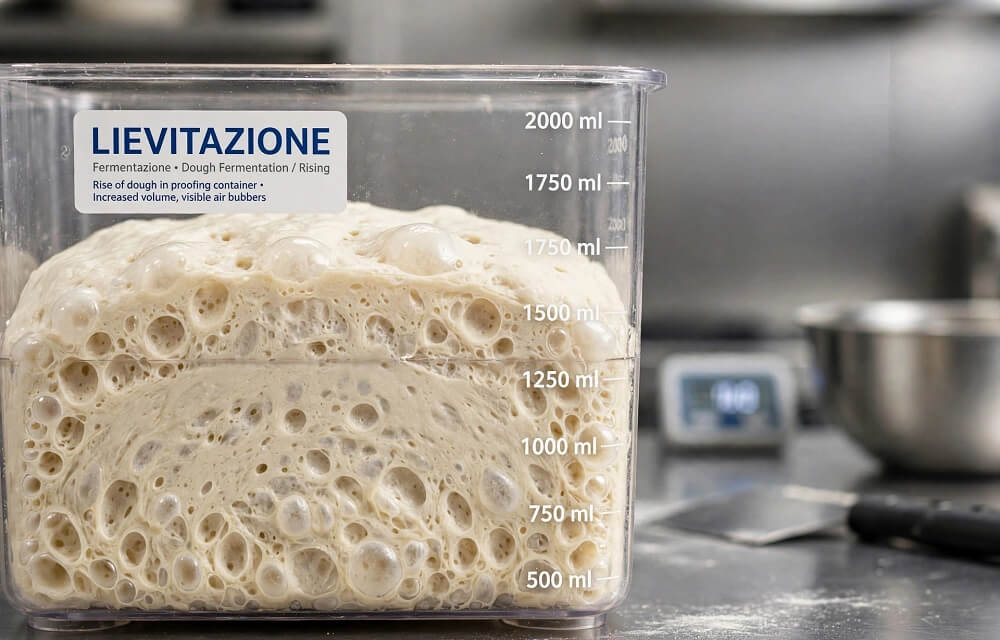
Fermentation (leavening) is the biological or chemical process by which a dough increases in volume through the production of carbon dioxide (CO₂). In professional baking, a distinction is made between biological fermentation — conducted by Saccharomyces cerevisiae or sourdough starter — and chemical leavening, achieved through leavening agents that react in the presence of heat or acidity.
Advantages for the professional
Biological fermentation with baker’s yeast (Saccharomyces cerevisiae) allows the professional baker to control timing, temperatures and aromatic development through three measurable parameters documented on the production data sheet:
- Yeast percentage of flour weight: typically 0.5–2%, inversely proportional to the desired fermentation time — lower percentage for long fermentations, higher for short direct doughs;
- Fermentation temperature: 24–28°C for direct fermentation at room temperature, 4–6°C for cold retard in the refrigeration unit;
- Fermentation time: from 1 hour (direct dough with high yeast percentage) to 16 hours (overnight cold retard in the refrigeration chamber).
Sourdough fermentation adds lactic and acetic fermentation by homo- and heterofermentative lactic acid bacteria to CO₂ production. The progressive acidification of the dough (pH 4.5–5.5 at the end of fermentation) inhibits the growth of moulds and pathogenic bacteria, extends the shelf life of the finished product without preservatives and develops a complex aromatic profile not replicable with baker’s yeast. These advantages are documentable on the product data sheet and directly relevant for commercial positioning in mid-to-high-end catering.
Cold retard fermentation at 4–6°C allows the baker to decouple dough preparation time from baking time. A dough prepared in the evening ferments slowly overnight and is baked in the morning without the need for staff during night hours: an operational parameter directly relevant for shift planning in laboratories with continuous production and labour cost optimisation.
Pain points resolved
Insufficient fermentation produces a product with a closed crumb structure, dense texture and flat aromatic profile — a defect not recoverable in baking. The operational causes are three: yeast dosage below the active threshold for the fermentation temperature, ambient temperature below 20°C that slows Saccharomyces cerevisiae metabolism beyond the compensation point, or fermentation time interrupted before the gluten network has reached the internal CO₂ pressure necessary for oven development.
Over-fermentation produces a dough with a collapsed gluten network, unpleasant acidity and reduced volume in the finished product — an irreversible defect that no modification in baking can correct. The causes are symmetrical: excessive yeast percentage relative to available time, fermentation temperature above 30°C that accelerates metabolism beyond the optimal maturation point, or fermentation time extended beyond the collapse point due to poor production cycle planning.
Temperature control is the critical variable of fermentation: every 5°C increase approximately doubles the fermentation rate of Saccharomyces cerevisiae. A dough at 28°C ferments twice as fast as one at 23°C. In a laboratory without active ambient temperature control, the same recipe produces radically different results in summer compared to winter. Cold retard fermentation in the refrigeration unit solves this problem by standardising fermentation temperature regardless of season.
A fourth pain point concerns the food safety of enriched doughs. A dough with high sugar content — panettone, brioche, croissant — fermented at temperatures above 30°C for extended periods can support the growth of non-Saccharomyces wild yeasts and undesirable lactic acid bacteria that produce abnormal metabolites. The laboratory’s HACCP plan must document the critical temperature and time limits for each type of leavened dough containing high microbiological risk ingredients.
Regulations and compliance
EC Regulation 852/2004 requires that the HACCP plan of the professional baking laboratory identifies fermentation as a critical stage of the production process, with definition of critical temperature and time limits for each type of dough. For doughs with high microbiological risk ingredients — fresh eggs, milk, butter — the fermentation CCP must include temperature control of the fermentation chamber with hourly recording or continuous monitoring via datalogger (electronic device that automatically records temperature at programmed intervals).
Sourdough fermentation is subject to the same HACCP obligations as baker’s yeast fermentation, with an additional complexity: sourdough starter is a living microbial ecosystem whose composition changes over time. The HACCP plan must document the sourdough management protocol as an Operational Prerequisite Programme (OPP): refreshment frequency, control pH (optimal range 3.8–4.5 after refreshment), titratable acidity (expressed in ml of 0.1N NaOH per 10g of sourdough starter, index of the degree of acetic and lactic fermentation of the starter) and storage temperature.
EU Regulation 1169/2011 applies to allergen declaration in bakery products sold directly to consumers: gluten is the first mandatory allergen to declare regardless of the leavening method used. For products marketed as “gluten-free”, the laboratory must implement cross-contamination prevention procedures documented in the HACCP plan, with analytical verification of residual gluten content below 20 mg/kg according to EC Regulation 41/2009.
Related terms in the BianchiPro glossary
- Gluten network — three-dimensional protein structure that retains the CO₂ produced during fermentation; the quality of the gluten network at the moment of baking determines the dough’s ability to develop in volume without collapsing under the pressure of fermentation gases.
- Autolyse — resting phase of flour and water without yeast or salt that precedes fermentation; the enzymatic development of the gluten network during autolyse improves the dough’s ability to retain the gases produced in the subsequent fermentation phase.
- HACCP — food safety management system in which fermentation must be identified as a CCP with critical temperature limits (max 30°C for enriched doughs) and time limits documented in the laboratory’s self-monitoring plan.
- Sourdough starter (levain) — living microbial ecosystem of wild yeasts and lactic acid bacteria used as an alternative leavening agent to baker’s yeast; produces slower fermentation, a lower final pH (4.5–5.5) and a more complex aromatic profile compared to Saccharomyces cerevisiae.
- Flour strength (W) — alveograph index measuring the flour’s resistance to deformation; a flour with adequate W is the precondition for correct fermentation: a gluten network that is too weak cannot sustain the pressure of the CO₂ produced and collapses before baking.
Products using this technology
BianchiPro’s spiral mixers and planetary mixers are designed to support all professional fermentation methods: from direct doughs with high yeast percentages to short post-autolyse cycles, through to indirect sourdough doughs with high hydration. The reduction in mechanical mixing time guaranteed by the spiral mixer keeps the dough temperature within the optimal 24–26°C range, preserving the fermentation conditions documented in the laboratory’s HACCP plan.
Technical FAQ
Fermentation is the process that causes dough volume to increase through the CO₂ produced by microorganisms or chemical agents. In professional baking, three main methods are used: biological fermentation with baker’s yeast (Saccharomyces cerevisiae), fast and controllable; sourdough fermentation, slower but with greater aromatic complexity and extended shelf life; chemical leavening with bicarbonate or baking powder, used for baked goods that do not require gluten network development (cakes, biscuits, muffins). The optimal fermentation temperature for Saccharomyces cerevisiae is 24–28°C for direct fermentation at room temperature. Below 20°C, fermentation activity slows significantly; above 35°C, yeast suffers thermal stress that compromises CO₂ production; above 55°C, yeast is irreversibly inactivated. For cold retard fermentation, a temperature of 4–6°C slows fermentation in a controlled manner, allowing cycles of 8–16 hours without risk of over-fermentation. An over-fermented dough can be recognised by three visual and tactile signs: volume increased beyond double the initial volume, surface with visible bubbles or sticky appearance, immediate collapse under finger pressure without elastic return. Prevention is based on three parameters: reduction of yeast percentage for long fermentations (0.1–0.3% for overnight), lowering of fermentation temperature (cold retard in the refrigeration unit at 4–6°C) and setting a monitoring timer every 30–60 minutes during critical stages of active room-temperature fermentation. Yes: fermentation must be identified as a CCP or CP in the HACCP plan with critical temperature and time limits defined for each type of dough. For doughs with high microbiological risk ingredients (fresh eggs, milk, butter), temperature monitoring of the fermentation chamber with hourly recording or datalogger is mandatory. For sourdough fermentation, the plan must also document the starter management protocol: refreshment frequency, control pH and titratable acidity as verifiable process parameters during sanitary inspection. Baker’s yeast (Saccharomyces cerevisiae) produces exclusively alcoholic fermentation with CO₂ and ethanol: fast leavening (1–4 hours), predictable result, simple aromatic profile. Sourdough produces alcoholic and lacto-acetic fermentation in parallel: slow leavening (4–12 hours), dough acidification (pH 4.5–5.5), extended shelf life through mould inhibition, complex aromatic profile with acidic, mineral and fermented notes. For high-end professional baking, sourdough is the technical choice that justifies premium product positioning. For doughs destined for long fermentation (overnight, cold retard, sourdough), the spiral mixer is preferable because it exerts less thermal stress on the dough mass: the spiral geometry works the dough with less friction than the planetary hook, keeping the dough temperature closer to the optimal 24–26°C for fermentation. The planetary mixer is more versatile for small volumes and medium-hydration doughs (60–70%); the spiral mixer is the professional choice for continuous production with high hydration (75–85%) and short post-autolyse mixing cycles.+ What is fermentation and what types exist in professional baking?
+ What is the optimal fermentation temperature for professional bread?
+ How do you recognise over-fermentation and how can it be prevented?
+ Must fermentation be documented in the baking laboratory’s HACCP plan?
+ What is the difference between baker’s yeast fermentation and sourdough fermentation?
+ Is a spiral mixer or a planetary mixer better suited for long-fermentation doughs?